In today’s blog, we will be discussing the infamous smiley face emoji, which averages around 500 million dollars in net worth every year. As a digital marketing company, we use emojis every day, across social media to help connect with our clients, texts and emails.
So how did this simple emoji forge such a large impact on our daily lives?
HOW IT WAS CREATED.
Well, we are sad to say the start of this story isn’t as happy as the emoji. It all began in Massachusetts in 1963 with an artist called Harvey. R. Ball. A life insurance company commissioned Ball to create a new design/logo. The goal of the new design was for it to be uplifting and boost employee morale. So, he decided to draw a simple smiley face on a yellow background. The original design took 10 minutes, and he received a payment of $45, which in today’s money would be around $450. Once the design was complete, he pushed it to one side and continued with his next project.
Ball’s design created a series of creations and others were quick to pounce on the icon’s popularity starting in a neighbouring state, Philadelphia. So, along comes two brothers; Bernard and Murray Spain, who decided to print the smiley face emoji onto buttons with the catchphrase “Have a nice day”. They sold around 50 million buttons in 1971, during the height of the Vietnam War.
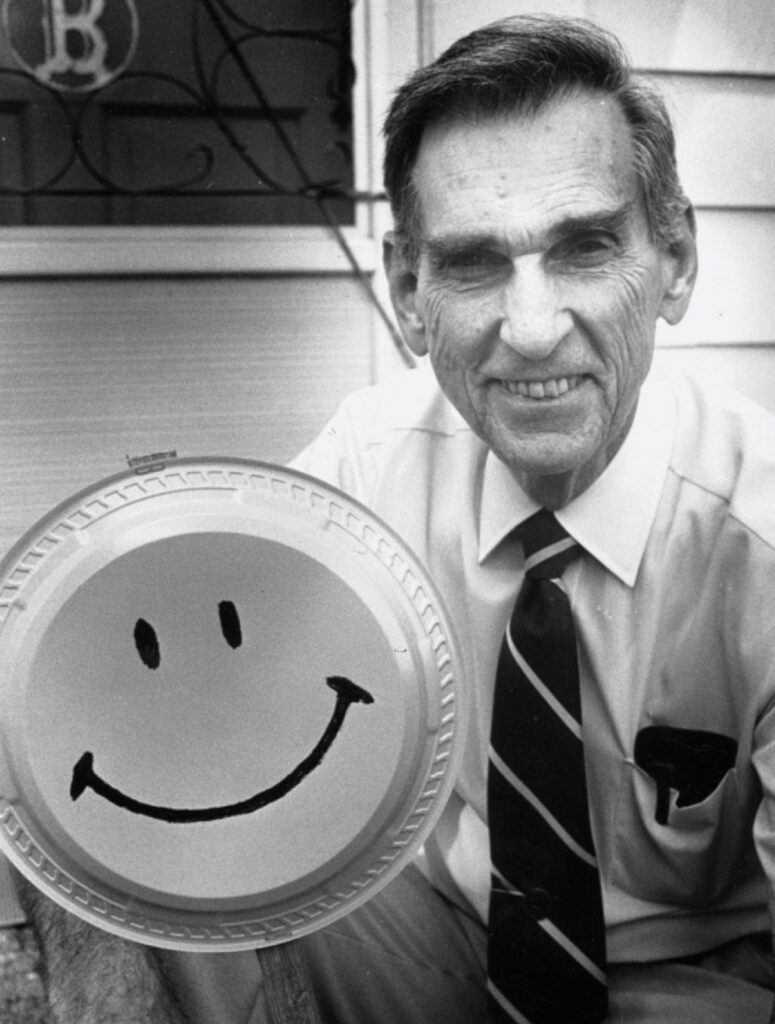
Typically it would be illegal to take someone else’s design. However, Mr Ball made a crucial mistake, he never trademarked the design! In turn, leaving it open to other companies to play around with and market themselves.
THE MAN WHO OWNS THE SMILEY FACE
Skip forward just a few years and the design was beginning to get recognition halfway across the world. A French journalist, Franklin Lourfrani, created his own smiley face drawing, with a similar resemblance to the original design. Lourfani used this concept while working on a Persian newspaper in the 1970s. He then decided to begin posting the infamous smiley face on the front page of the newspaper to highlight good news. This occurred because the newsletter was known to only highlight bad news. Doesn’t seem like much has changed, right?
Unlike Harvey Ball, Franklin had seen the potential of this symbol’s marketing potential and immediately secured a French trademark.
After it ran in a newsletter in January of 1972, other newspapers began to show interest and started paying the rights to use it. But, Franklin wanted to broaden the reach of the word and thus chose to engage in a larger marketing opportunity.
THE FREE LOVE MOVEMENT
During the French free love movement, Franklin decided to hand out 10,000 smiley face stickers to the local people. Around 2 years later, Franklin received brand deals with companies such as Mars Candy and Levi Jeans. He didn’t stop there, the smiley face was sent to all sorts of manufacturing companies; from bags and t-shirts, to posters and badges. Becoming the staple icon across the rave community during the late 80s and early 90s.
As the business began to grow, it became apparent it was too much for one man. In the late 1990s, Franklin asked his son Nicolas to get involved as an operational manager. At this time business wasn’t high and licensing deals were down, so the logo started to lose its appeal. That’s when they decided to make the logo into a company, ‘The Smiley Face’ company.
As the digital age grew and more companies heard about this company, the Loufranis decided to partner up with big companies such as Nokia and Samsung. From these brand deals, Nicolas, against the wishes of his father, made major updates to the smiley face. He began morphing it from a static image to a 3D orb. After the new smiley was created, they began creating emojis of all different emotions and licensed them out to companies such as Apple and Microsoft. To this day they are known for their creations and how they created a new way of communicating.
THE SMILEY FACE EMOJI TODAY.
To this day, Nicolas and his father, who is in his 70s, still run the business together. The smiley company grosses nearly 500 million dollars per year in licensing deals. Though royalty fees can vary, the smiley company makes as high as 10% of what an item sells for.
So it leaves us with the wandering question of what happened to Harvey Ball? Well sadly he passed away in 2001 at the age of 79. Harvey never profited from the smiley, apart from the original $45. However, years later Harvey’s son was interviewed, and reported saying ‘his father had no regrets and that the smiley in his father’s opinion had served its purpose.’
We use all sorts of emoji’s and characters across our writing today and it’s strange to think where we would be without the iconic smiley face emoji! A new idea can be an amazing thing, when it begins to blossom and you see the reward.
But, don’t make the same mistake as Harvey; look into trademarking your concepts today!
If you are having a similar issue contact our sister company Fresh Business Solutions.


0 Comments